Soweto at 50
“The histories of our two peoples, Palestinian and South African, correspond in such painful and poignant ways.” Nelson Mandela, 1999
16th June marks the 50th anniversary of the Soweto uprising
On the morning of 16th June 1976, students from local schools took to the streets of Soweto to protest against the introduction of Afrikaans as the medium of instruction in Black schools. Afrikaans was considered by most Black South Africans as the language of the oppressor.
An estimated 20,000 students took part in the protest. By the end of that day, 176 pupils had been killed in a brutal police crackdown. The uprising sparked unrest throughout South Africa and became a pivotal moment in the fight against apartheid — renewing opposition to the regime both at home and internationally.
16th June is now known as Youth Day in South Africa and as the Day of the African Child worldwide.
Amos Trust campaigned against the apartheid regime in South Africa, and we continue to campaign against Israel’s apartheid policies towards Palestinians. That struggle for freedom has shaped our work as we continue to partner with organisations in both countries.
This week, we’ll be remembering the Soweto uprising and looking — through that moment in history — at what the future holds for both South Africa and Palestine today. We’ll be sharing a series of posts and a webinar exploring:
- the events of 50 years ago
- the power of young people to drive change
- the parallels between South African and Israeli apartheid
- the failure to deliver the change young people campaigned and died for in South Africa
- the power of photography and film to change opinion
The betrayed generation
The young people marching in Soweto were demanding dignity, education, equality and the freedom to shape their own futures. The end of apartheid in 1994 carried the hope that those things would finally arrive.
For too many of South Africa’s young people, they haven’t.
Youth unemployment has worsened since 1994. In the first quarter of 2026, unemployment stood at 61% for those under 24 and 41% for those aged 25 to 34. Much of the so-called “born free” generation has been born into joblessness. The exclusion that apartheid physically built into cities and townships — keeping Black South Africans far from jobs, good schools and investment — didn’t disappear when the laws changed.
The young people that our partner uMthombo meets on the streets of Durban still carry the legacy of the apartheid years with them. They arrive there as a result of family breakdown, gender-based violence and an economy that has no place for them. South Africa’s gender-based violence crisis is among the worst in the world, with femicide rates five times the global average. Whoonga and other heroin-based drugs have taken a devastating hold on young people who often have little else to hold onto. The streets of central Durban offer some shelter — but not safety, and certainly not the future that was promised.
This is the world that uMthombo works in every day. The young people they support are not a footnote to the story of post-apartheid South Africa. Fifty years on from Soweto, their lives are a measure of how far there is still to go.
And yet there are stories from uMthombo that point in a different direction — young people who have found safety, managed to leave heroin behind, rebuilt relationships with their families and taken a first step back into education or work. In a country where so many young people have been told they don't matter, being seen and believed in can be where everything changes.
South African and Israeli apartheid
“I know first-hand that Israel has created an apartheid reality within its borders and through its occupation. The parallels to my own beloved South Africa are painfully stark indeed.” Archbishop Desmond Tutu, 2014
As early as 1976, Israel’s fifth prime minister, Yitzhak Rabin, expressed concern about apartheid if Israel were to annex the West Bank. Throughout the 1980s and 1990s, the parallels between Israel’s policies and South African apartheid were increasingly drawn — though not always openly stated.
Following the Oslo Accords in 1994 and their failure to deliver a two-state solution, Palestinians and Israeli activists began using the term apartheid openly to describe Israel’s policies and actions. In 2005, Israeli Apartheid Week and the Boycott, Divestment and Sanctions movement were both launched. It would be another 14 years before the first major legal report accusing Israel of the crime of apartheid was published — by the Palestinian NGO Al-Haq — followed by equally comprehensive reports from Human Rights Watch, B’Tselem and Amnesty International.
Since October 2023, Israel’s apartheid laws and actions have become more extreme. As Israel moves to annex the West Bank, there is a near-total absence of legal redress for escalating settler violence, land seizures and killings of Palestinians carried out by the IDF. The legal system has become increasingly weighted in favour of Jewish Israeli rights over those of Palestinians — most notably through the passing of the Death Penalty for Terrorists Law, which mandates capital punishment by hanging for Palestinians convicted in military courts of offences classified as terrorism-related. The lack of impartiality of these courts has been repeatedly documented: over 96% of cases result in conviction, with only 0.3% of Palestinians exonerated.
Human Rights Defenders Fund, January 2026
Photography and film
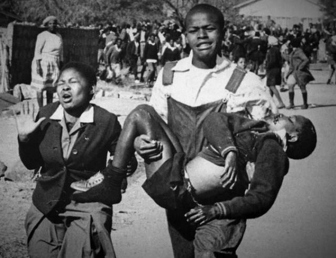
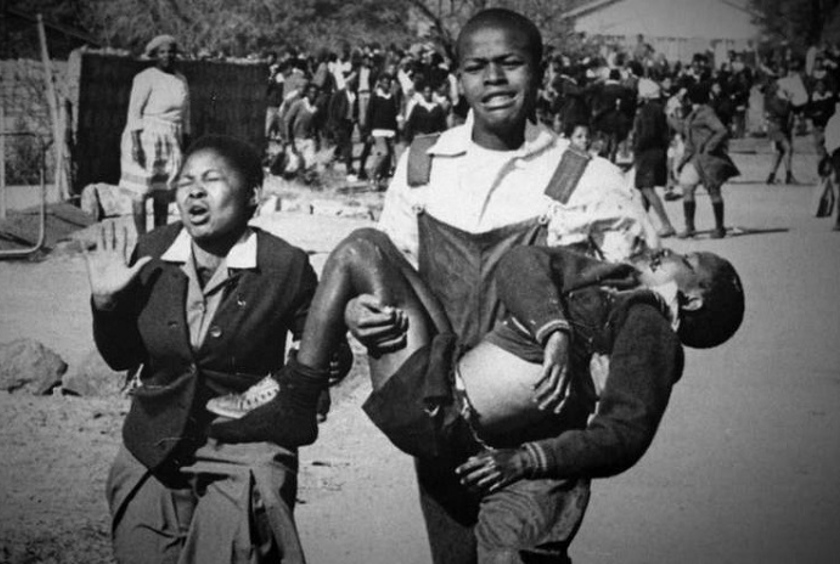
Main image: Mbuyisa Makhubo carries Hector Pieterson
Sam Nzima’s photograph of Mbuyisa Makhubo carrying the fatally wounded 13-year-old Hector
Pieterson is the defining image of the Soweto uprising. Taken on 16th June 1976 and published in The World — a Black daily newspaper based in Johannesburg — the image shows Makhubo running with Pieterson’s limp body, accompanied by Pieterson’s distraught sister, Antoinette Sithole.
The photograph immediately became a national and international symbol of the brutality of apartheid and helped consolidate global opposition to the regime.
The murder of Mohammed Al-Durrah
The filming of the killing of 12-year-old Mohammed Al-Durrah in Gaza on 30th September 2000 — two days after the start of the Second Intifada — by journalist Talal Abu Rahma, shocked the world.
On 16th July 2014, four boys from the Bakr family, aged between nine and eleven, were killed as they played football on a Gaza beach. The first Israeli shell killed one child; a second killed the other three as they tried to escape. Four more children from the Bakr family and two civilians nearby were also wounded.
On 29th January 2024, five-year-old Hind Rajab was murdered alongside her family in an act of devastating violence by Israeli Defence Forces. Hind survived the initial attack but was left trapped in the wreckage, surrounded by the bodies of her family. Her cries for help — captured during a live call to emergency services — were broadcast worldwide. When an ambulance arrived, it too came under fire and its occupants were killed. The inhumanity of this calculated act reverberated globally.
Each of these moments — reported and filmed at enormous personal risk — has generated shock, anger and international solidarity. There are many more such examples from Palestine and Lebanon, each highlighting the vital importance of independent journalism. It is why Israel continues to ban international journalists from entering Gaza, and why it continues to target and kill those who bear witness — from the killing of acclaimed Al Jazeera journalist Shireen Abu Akleh to the 270 journalists killed in Gaza since October 2023.
We Are Not Numbers
It is for this reason that we partner with We Are Not Numbers — an organisation set up to train and equip young writers in Gaza and provide a platform for them to tell their stories to an international audience. Since the start of the genocide, many of their young writers have become Gaza’s journalists. For the past two and a half years, we have worked alongside We Are Not Numbers to support these writers as they document the ongoing genocide, tell their personal stories and shine a light on conditions on the ground.