Bits of Hope at COP30: Part 2
Meet Melissa Cáceres and Latinas por el Clima — Latin American women pushing for gender and climate justice at COP30 through research, advocacy and grassroots action.

Bits of Hope at COP30: Part 2
Today, on International Women’s Day, we want to honour the work and resistance led by women across Latin America — work not only for gender justice, but also for climate justice.
In this context, we return to our blog series titled “Bits of Hope at COP30”, sharing stories from activists and land defenders — participants of the Climate Fellowship — who had the opportunity to attend the most recent COP
In this second instalment, we spoke with Melissa Cáceres from Honduras, a participant in the first cohort of the Climate Fellowship. Melissa is a member of Latinas por el Clima, a network of Latin American women working together for climate justice. Melissa’s project on the Amos Climate Fellowship was presented at COP30.
Latinas por el Clima
Their first official delegation at COP30
Although COP30 was Melissa’s third COP, it was the first time that Latinas por el Clima attended as an official delegation. The fact that the COP was taking place in Latin America — combined with the urgent need for strong civil society presence from the region — were the two main factors that motivated their decision. This year, they prepared a full year in advance, arriving with a clear agenda focused on two major projects:
- “Latinas reporting from the COP”
A communications project designed to explain, in real time, what was happening inside the conference through stories, videos, TikToks and social media posts. The aim was simple but essential: to translate the technical language of the COP into formats that Latin American audiences could understand and engage with. - Research on Women and Climate Change
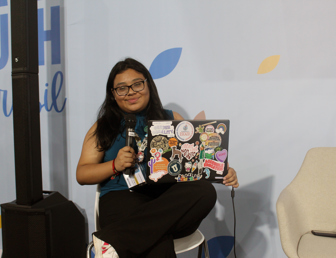
As part of the Amos Climate Fellowship, we supported Melissa in developing this project in partnership with Latinas por el Clima. Their preliminary findings — drawn from stories shared by women across the region — were presented in several key spaces inside and outside the COP: the Children and Youth Pavilion in the Blue Zone, the Climate Preparation Hub, and the People’s Summit, a parallel gathering led by Indigenous peoples and grassroots Latin American organisations.

Presentation of the Research on Women and Climate Change in the People’s Summit
Melissa summarised the intention behind the research clearly:
“Something we emphasised in one of our events is that our research will never be able to reflect 100% of the lived experiences of women in Latin America in relation to climate change — but we hope this will be a first step.” Melissa Cáceres
Their findings highlighted:
-
A rise in extreme climate events (floods, droughts, heatwaves)
-
Forced climate-related migration
-
Safety concerns in shelters for women, girls and gender-diverse people
-
The loss of ancestral knowledge due to displacement
These insights enabled them to connect their research directly to negotiations on loss and damage, which was essential for gaining visibility in specific COP spaces.
Why is it worth the effort?
Melissa explained that activists must make an enormous effort simply to be present at the COP. Securing accreditation — the official UN permit that allows an organisation’s delegates to access the Blue Zone, where negotiations take place — is already a major challenge.
For networks like Latinas por el Clima, which are not accredited with the UN, this means sending thousands of emails to accredited organisations in the hope that one of their members can be granted access, often only for specific days or limited periods. On top of this, activists must also secure funding to cover two weeks of travel, accommodation and living costs.

Latinas por el Clima official delegation
Despite these barriers, Melissa emphasised that COP30 once again demonstrated how essential civil society is in pushing negotiations forward and ensuring that vulnerable communities are not excluded.
One example was the Belém Action Mechanism (BAM), a framework outlining a more concrete pathway towards a just transition that recognises all vulnerable sectors of society. As Melissa described it, “It’s a plan to secure a just transition, but one that really includes all sectors of society. It looks at how you incorporate gender, Indigenous peoples, children, people with disabilities — all the vulnerable groups.”
She explained that this mechanism was only possible because of the sustained advocacy of the constituencies — large coalitions representing entire sectors, such as the Women and Gender Constituency and YOUNGO (children and youth). Acting as umbrella spaces, they bring together dozens, sometimes hundreds, of organisations to amplify collective demands. They pushed for a mechanism that genuinely included women, children and people with disabilities, arguing that previous just transition efforts had been too weak and had left many sectors behind.
“It’s a plan to secure a just transition, but one that really includes all sectors of society. It looks at how you incorporate gender, Indigenous peoples, children, people with disabilities — all the vulnerable groups.” Melissa Cáceres
Civil society also led powerful actions beyond the negotiation rooms. One was a historic march of more than 70,000 people through Belém, outside UN-controlled spaces — a visible reminder of the strength of social movements on the ground. Melissa recalled how they walked across the city carrying banners and flags, describing it as something that had not been seen in many years.
Perhaps the most striking moment came from Indigenous peoples. In an unexpected collective action, a community blocked entry to the Blue Zone, demanding to be heard by the COP Presidency. They refused to move until the Presidency agreed to meet them — and the pressure worked. As Melissa noted, “After that march, Brazil recognised ten new Indigenous territories… they took the process into their own hands.”
Why civil society must continue
Melissa was clear that stepping away has consequences. As she put it, “If I stop going, that’s one more accreditation for a lobbyist.”
She pointed out that this year, for every 25 fossil fuel lobbyists present, there was only one Indigenous representative — a stark imbalance that underscores why civil society’s participation is not optional, but urgent.
Melissa was clear that stepping away has consequences. As she put it, “If I stop going, that’s one more accreditation for a lobbyist.”
For Melissa, attending the COP is not an act of naïve optimism, but one of political and ethical responsibility. Progress in these spaces is slow, she acknowledged, yet it becomes even slower when human rights defenders, young people and grassroots movements are absent from the room. Their presence is essential to question the process itself and to push negotiations towards greater accountability.
This is why Latinas por el Clima remains determined to endure, ensuring that Latin American youth continue to take up space in global climate negotiations. As Melissa reflected, “Latinas is more than one person… We are more than 100 girls, and thousands in the wider community. I don’t know if I will be at every COP, but I want Latinas to be at every COP.”
Latinas por el Clima reminds us on International Women’s Day that the fight for gender justice does not belong to a single day, but is sustained every day. Through the Research on Women and Climate Change, the importance of including the voices and perspectives of women and girls in climate action is being brought to the forefront.

Sofia Mendoza and Melissa Caceres both from Latinas por el Clima presenting in the Climate reparation hub
The final version of the report will be ready in the next few weeks. We look forward to sharing more of the findings of this research and seeing how they contribute to advancing climate action led by women across Latin America.